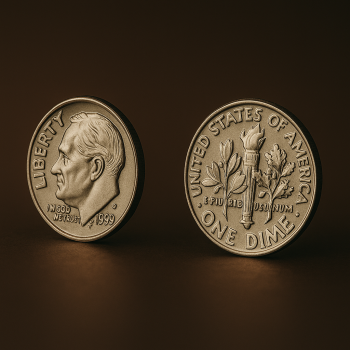
A dime has two sides: heads and tails. Regardless of which side faces up, you can tell you are holding a dime. The coin is inherently worth 10 cents even if you can’t see the side that is facing down. Simply by looking at one side you can describe the other.
Humility, the great quality of Jesus so richly described and often mentioned in Scripture, also has two sides. There is the outward side, which is behavioral and easily observed by others. Some people have a “low look,” they are obviously unaggressive and exhibit virtually no pride. Jesus said about Himself “Take My yoke upon you and learn from Me, for I am gentle and lowly in heart, and you will find rest for your souls.” (Matthew 11:29)
The other, inward side of humility is less understood and yet no less vital. Jesus mentioned this quality in the opening moments of His first major address on a hillside near the Sea of Galilee. He said, “Blessed are the meek, for they shall inherit the earth.” The original Greek word for this quality is prautes; an inward grace, a belief that God is mindful of me and deserves to be trusted. Prautes accepts that what occurs to me has been pre-examined and authorized in heaven. The inward side of humility trusts that God knows all about the conditions of my life, has approved them and is using them for my sanctification and His purposes. Prautes believes that all things work together for good to them that love the Lord and are called according to His purpose (Romans 8:28). Unfortunately, this ancient Greek term has no reasonable translation in English. We are left using the word “meek” which is fraught with connotations of weakness (especially in America). Meekness implies one is a doormat or an unassertive individual. Meekness is a quality at odds with our culture, so it is disparaged by many.
Both the outward behavior and the inward grace are vital to the development of authentic, Godly humility. Meekness stems from an acceptance of God’s infinite wisdom, His total awareness and His faithfulness. When this quality is added to an outward display of pridelessness, one demonstrates Biblical humility. As a spiritual son, this individual will then be entrusted with governance over the Lord’s creation. He “inherits the earth,” meaning he is tested and eventually assigned with responsibilities as a representative of the Lord’s Kingdom.