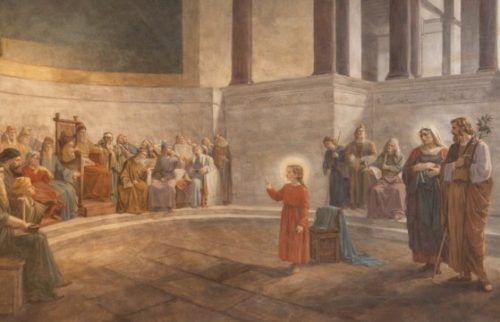
Early in the Gospel of Luke we find a familiar story where Mary and Joseph are frantically searching in Jerusalem for three days, looking for their 12-year-old son Jesus.
Finally finding Him in the Temple, speaking with the elders, the boy asks his parents, “Why did you seek Me? Did you not know that I must be about My Father’s business?” These are His first recorded words, and they reveal an early awareness of His divine assignment. It speaks to His identity as the Son of God.
Let’s unpack the backstory and then search for the wisdom in this important passage. Prior to this event, we find one simple report in the Bible about His early years:
And the Child grew and became strong in spirit, filled with wisdom; and the grace of God was upon Him.
Luke 2:40
That alone is a great report. At age 12, Jesus was already ’filled with wisdom.’ That comes from studying and applying the Mosaic Law and the other historical records of God’s people. He received the ‘grace of God’ as well, which is an empowering quality allowing us to apply the Lord’s will in a variety of situations. Without God’s grace we are likely to use our own intellect or emotional energy to conduct our lives.
Now we have the drama of watching Jesus in the Temple, testing whether He’s mature enough to begin His legendary mission.
His parents went to Jerusalem every year at the Feast of the Passover. And when He was twelve years old, they went up to Jerusalem according to the custom of the feast. When they had finished the days, as they returned, the Boy Jesus lingered behind in Jerusalem. And Joseph and His mother did not know it; but supposing Him to have been in the company, they went a day’s journey, and sought Him among their relatives and acquaintances. So when they did not find Him, they returned to Jerusalem, seeking Him.
Luke 2:41-45
Like any parents, they are desperate to find their lost child.
Now so it was that after three days they found Him in the temple, sitting in the midst of the teachers, both listening to them
and asking them questions. And all who heard Him were astonished at His understanding and answers. So when they saw Him, they were amazed; and His mother said to Him, “Son, why have You done this to us?
Look, Your father and I have sought You anxiously.”
Luke 2:46-48
Jesus is amazed that they are amazed! Don’t they know that He’s on a heaven-sent assignment?
And He said to them, “Why did you seek Me? Did you not know that I must be about My Father’s business?” But they did not understand the statement which He spoke to them.
Luke 2:49-50
————————————————-
This remarkable story rivets our attention. At age 12, Jesus has matured enough to be keenly aware of His supernatural mission. For the first time, He refers to the Lord God as His Father. He conveys a sense of curiosity, seemingly saying to His mother, “You know who I am; you know the mystery of My birth. Why are you so surprised that I am drawn to be here, in my Father’s house?” The passage tells us that Mary then began to wisely “keep”, or store, these anecdotes in her heart.
Not yet a teenager, Jesus realizes that He needs to be responsive to His heavenly Father. In the one direct quote provided in the text, the original Greek wording is not clear. The phrase: “about my Father’s business” might mean to “stay in My Father’s Temple” or perhaps “stay focused on My Father’s affairs.” Either way, it leaves us with a sense that the boy was already highly attentive to His singular destiny.
————————————————-
Let’s unpack the exact phrasing of “…I must be about My Father’s business.”
“I Must“: The phrase “I must” (Greek: dei) indicates an inner, divine compulsion. He is driven to fulfill His purpose, showing that even at 12, Jesus was ready to obey God. Of course, He shouldn’t have attempted to launch His ministry prematurely, but His intentions are honest and clearly evident.
“Be about”: Here Jesus gently reminds His parents that his allegiance to His heavenly Father takes precedence, foreshadowing His future ministry.
“My Father’s business:“ Notice that the child does not disrespect His adoptive father, Joseph, but He does acknowledge His heavenly Father’s assignment. This speaks to His unique, divine origin and His life’s ultimate purpose. While translated in Scripture as “my Father’s business,” the Greek phrase implies His need to be in His Father’s house (the Temple) or perhaps engaged in His Father’s affairs.
This event represents a turning point where Jesus first began to move from the immaturity of childhood into his public mission, which began later in his life.
————————————————-
After this adventure in Jerusalem, the Bible reports that Jesus spent another 18 years becoming more mature in four specific ways:
Then He went down with them and came to Nazareth, and was subject to them, but His mother kept all these things {rhemas – that which Jesus said} in her heart. And Jesus increased in wisdom and stature, and in favor with God and men.
Luke 2:51‐52 NKJV
The Four Qualities
- WISDOM ‐‐ sophia – insight into the true nature of things.
The opening passage of John’s Gospel reads: “In the beginning was the Word, and the Word was with God, and the Word was God” John 1:1. Jesus was the Truth, housed in a person. However, in the great mystery of His life, He was also a human male. In that capacity He studied and meditated upon the Law of Moses and the sacred historical and prophetic writings. We have a sense that the young Jesus, knowing His destiny, applied Himself diligently for many years to acquire the wisdom He would need to refute the Pharisees, the lawyers and eventually the Devil himself. If we were to imitate Jesus in this first stage, we would engage in a program of reading, memorizing and engrafting passages of Scripture. We would pray to enhance our relationship with the Father and to align our will with His. We would release our faith, realizing that “every good gift and every perfect gift is from above, and comes down from the Father of lights…” James 1:17 and that “without faith it is impossible to please God.” Hebrews 11:6
- STATURE ‐‐ helikia – this word can refer to one’s height or age.
In the Sermon on the Mount, Jesus asked “Which of you by worrying can add one cubit to his stature?” Matthew 6:27 In this passage, Luke seems to be saying that as the years proceeded, Jesus grew up healthy and normally just as any other young, Galilean, Jewish man of His era. If we were to imitate Jesus in this second stage, we would take care of our body, as the temple of the Holy Spirit, and keep ourselves, as Jesus did, from an impure life. Conversely, like Jesus, we would avoid those things which can adversely affect our health and the ministry we are called to.
- FAVOR WITH GOD – charis – this is grace, pure and simple.
Grace is the power and desire to accomplish God’s will. In Jesus’ day Israel operated under the Law of Moses. Jesus introduced a new dispensation, built on charis, or grace. Think of grace as a form of supernatural fuel. With grace we can run and never get weary. Jesus received massive amounts of grace during his youth. This seasoned His words, even at the tender age of 12, thereby amplifying their power and authority. God gives greater deposits of grace when we display humility and when we voluntarily turn away from the corruptions and enticements of the fallen world. Undoubtedly, the Lord was watching and discipling His own Son during these years.
- FAVOR WITH MEN – charis
Although the actual phrase is “favor with God and men” we can permissibly separate the two to obtain the full sense of the wording. Grace is a friendly disposition from which kindness and gentleness proceed ‐‐ a quality that brings pleasure to others. One has the sense that the nine fruit of the Holy Spirit, described in Galatians 5, were growing abundantly on Jesus, winning Him a favorable reputation among his family and neighbors. Charis gave Him the insight on how to get along well with others.
————————————————-
In summary, we see evidence of the maturation process that Jesus undertook, both spiritually and humanly. We are wise to consider the value of this approach in raising our own children and in submitting ourselves to a personal growth process. Jesus had a strong sense of His personal calling; He knew the need to remain close to His heavenly Father during the process; He submitted to His earthly parents during those years. In time, He left home and began the most influential mission in history.