Roughly 2,500 years ago, a Jewish exile named Nehemiah, working in a Persian palace, received several visitors from his homeland of Judah. Although that country had been ransacked decades earlier, the Lord allowed a few thousand Jews to remain. In the first chapter of this story, these visitors described to Nehemiah the relentless, miserable living conditions of those still living in Jerusalem. Let’s listen to their heartbreaking report — shown in the first three verses:
The words of Nehemiah the son of Hachaliah. And it happened in the month Chisleu, {December} in the twentieth year {of Artaxerxes’ reign}, as I was in Shushan the palace, Hanani, one of my brothers, came, he and men of Judah. And I asked them concerning the Jews who had escaped, who were left of the {Babylonian/Persian} captivity, and concerning Jerusalem. And they said to me, “The remnant left of the captivity there in the province is in great affliction and shame. And the wall of Jerusalem is broken down, and its gates are burned with fire.”
At this point, we don’t know much about these struggling Israelites in Jerusalem (“the remnant”), but we certainly notice the stark description of their suffering. A small scrap of curiosity and empathy might provoke us to ask:
- Who are these disgraced people?
- Why are they called a “remnant of the captivity?”
- Whatever happened to the twelve tribes of Israel, who conquered Palestine, the land of milk and honey, and established a government designed by God under His leadership?
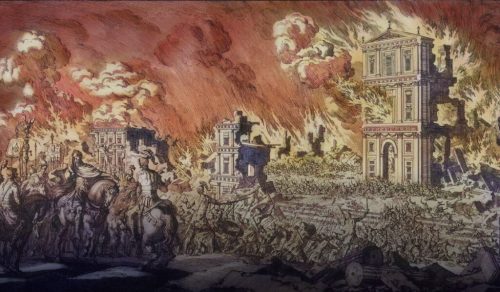
Sitting in the beautiful Persian palace while his brother is speaking, Nehemiah remembers the prophetic warnings of judgment, culminating over 150 years earlier in the deadly battles around Jerusalem. Around 586 B.C., in a series of attacks over 19 years, Nebuchadnezzar, King of Babylon, conquered the tiny territory of Judah which was all that remained of the Jewish homeland. The king transported most of the inhabitants to foreign lands. The fierce Babylonian warriors then looted Solomon’s Temple and burned the magnificent city of Jerusalem to the ground. Twenty thousand refugees scattered into the Judean hillsides as the only citizens remaining from the once-powerful country, promised to Abraham, discovered by Moses and conquered by Joshua, which King David then ruled some 400 years earlier, around 1000 B.C.
For centuries, the nation of Israel had received repeated warnings from several prophets — follow God or fall to ruin. Knowing their rebellious tendencies, Moses, Elijah, Isaiah, and Jeremiah warned God’s chosen people of chastisement and destruction if they disobeyed the Lord’s commandments. After Solomon’s death, good kings and evil kings cycled through Israel and its sister state of Judah for 40 decades. Some worshipped the Lord while others built stone and wooden idols. These latter governments were led by men devoid of Godly virtue; their citizens openly rejected Jehovah God.
Angered beyond measure, the Lord finally acted. As predicted by the prophets, He released His fury and fulfilled His judgment on Judah because it strayed so very far from His commandments. In times past, God had passed harsh judgment on His people in a terrible manner. He used a worldwide flood to cleanse the earth of habitual evil. After the rebellion at the foot of Mount Sinai, He told Moses to lead the Jews through the harsh desert for 40 years while one generation died and a new generation arose. Finally, in the sixth century B.C., disgusted with the unrepentant hearts of His chosen people, the Lord incited the brutal, heathen empires of Assyria, then Babylon, to attack the Holy Land. Cities burned, including Jerusalem, and the middle and upper classes were marched off to live in foreign territories, shattering the Jewish culture and fulfilling the prophetic warnings. The overthrow of the Promised Land was not simply the result of territorial greed and geopolitical power, but was provoked by deep, widespread idolatrous sin resulting in spiritual judgment released by an angry God.
Looking at history through the narrow lens of the “victims” we are apt to offer pity without understanding. As God’s people disregarded clear, repeated warnings, they became their own persecutors. If you instruct your child not to leave his bike outside overnight, is he an innocent victim when someone steals it? The danger of studying historical events with a secular mindset is that we miss the hand of God. He sets standards and observes our works. He blesses our compliance. However, if we stray, He warns, He rebukes and eventually, He punishes. However, in His infinite mercy, God searches for someone to repent, saying, “If My people who are called by My name will humble themselves, and pray and seek My face, and turn from their wicked ways, then I will hear from heaven, and will forgive their sin and heal their land.”
2 Chronicles 7:14
Proving how the Lord moves in the background of history, Isaiah the prophet predicted the fall of Jerusalem 100 years before Nebuchadnezzar conquered Judah. Isaiah also described, decades in advance, the subsequent rise of the Persian empire and he identified, by name, the man Cyrus, who would conquer Babylon. History confirms the prophet’s writings. Cyrus of Persia defeated Babylon by entering the vast, walled city through the dry river bed, precisely as Isaiah had predicted. To keep his covenant with Abraham and provide a homeland for His coming Son, the Redeemer of Mankind, God arranged a plan to return two of the twelve scattered tribes back to Jerusalem after a lengthy captivity in Babylon.
Isaiah prophesied that Cyrus would permit the first group of exiles to return to their conquered Jerusalem, “Who says of Cyrus, ‘He is My shepherd, And he shall perform all My pleasure, saying to Jerusalem, ‘You shall be built,’ and to the temple, ‘Your foundation shall be laid.’ Thus says the LORD to His anointed, to Cyrus, whose right hand I have held; to subdue nations before him and loose the armor of kings, to open before him the double doors {of Babylon}, so that the gates will not be shut” Isaiah 44:28 — 45:1
After Cyrus ascended to the throne of the Persian Empire, thousands of Judeans were released from captivity. In 536 B.C., the first exiles returned to Judah to rebuild and repopulate the land. Led by Zerubbabel, this group built the new Temple in Jerusalem and reintroduced the ancient laws and worship guidelines given to Moses. A second wave of exiles arrived eighty years later, under military escort from Artaxerxes, the new Persian king. Ezra the priest used this time to refurbish the temple and replaced its stolen artifacts.
Progress in rebuilding the nation came slowly. Without wise governmental leadership, the pioneers in Jerusalem lived a disjointed and discouraging existence. Ezra provided religious guidance, but the land also needed a practical man, a strategic thinker, one who could restore a sense of dignity and purpose. The city needed an organizer, a man to dispel confusion, restore security and remind the people of the hope found in uncompromising adherence to the Word of God.
You and I would form a “Governor’s Search Committee” and look for such a man among the educated, wealthy gentry of the land. We would perhaps start a para-church ministry (Wall Builders of Jerusalem), appoint an Executive Director, begin fundraising and circulate a volunteer petition at the weekly Temple meeting. Such is the danger of a man-centered solution to a God-sized problem. Instead of taking that earthly approach, would you believe that a sovereign God may have developed another answer? Is the Lord hampered by difficult circumstances? “Is anything too hard for the LORD?” Genesis 18:14 To recruit the right man, could He reach across hundreds of miles of open desert to raise up a humble, powerless man named Nehemiah to accomplish the Herculean task of rebuilding Jerusalem’s walls? Would that man have the heart to utterly repent for the sins of his predecessors? Remember— the Lord wants to show mercy, but he needs to see repentance first.
The stage is now set. Jerusalem has a godly leader, Ezra, but lacks an operational expert. The Jewish people need to reconstitute their social structure to regain dignity as a nation. Jesus is coming in 400 years, so the Lord needs to establish a flourishing region by the time He arrives. Preparing for this transition, God reaches out to a powerless exile, a man named Nehemiah — one who is gifted, but humble; one positioned next to a powerful king who can supply all the resources needed to accomplish the mighty task of rebuilding Jerusalem’s walls.