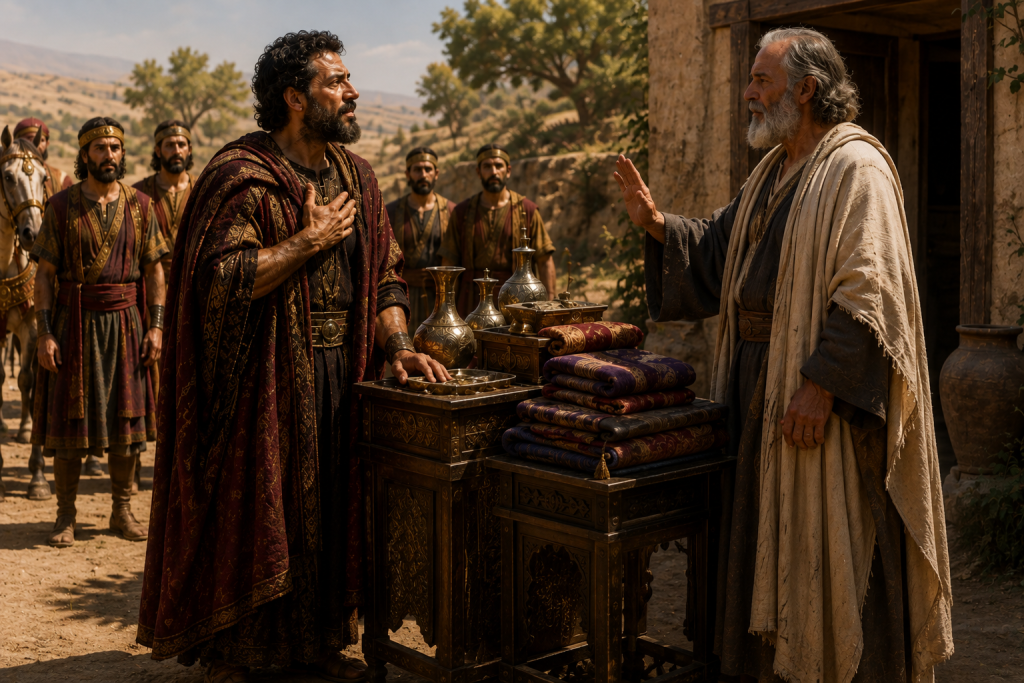
In the ancient Middle East, the skin ailment of leprosy often disfigured the patient. It also produced a social stigma that required the individual to tear their clothes and shout “Unclean, unclean” when in public. In 2 Kings chapter 5, the Bible records a vivid story about Naaman, a well-respected Syrian military leader afflicted with this disease. He visited Elisha, the mighty Israeli prophet, in search of his healing powers.
Now Naaman, commander of the army of the king of Syria, was a great and honorable man in the eyes of his master, because by him the Lord had given victory to Syria. He was also a mighty man of valor, but a leper. And the Syrians had gone out on raids and had brought back captive a young girl from the land of Israel. She waited on Naaman’s wife.
Then she said to her mistress, “If only my master were with the prophet who is in Samaria! For he would heal him of his leprosy.” And Naaman went in and told his master, saying, “Thus and thus said the girl who is from the land of Israel.” Then the king of Syria said, “Go now, and I will send a letter to the king of Israel.”
In this passage, Naaman learns of a spiritual solution to his physical problem. He takes the matter before the Syrian King who willingly writes a letter to the King of Israel asking for his help in healing Naaman. Unfortunately, this is a misinterpretation of what the young girl mentioned to Naaman’s wife. It runs the risk of stirring up unintended political problems. Naaman prepares for his trip to Israel with the letter and a number of valuables to bless the man of God for his help.
So, he [Naaman] departed and took with him ten talents of silver, six thousand shekels of gold, and ten changes of clothing [approx. $3 million in modern value]. Then he brought the letter to the king of Israel, which said, Now be advised, when this letter comes to you, that I have sent Naaman my servant to you, that you may heal him of his leprosy.
I don’t know who caused the confusion, whether it was Naaman, the Syrian King, or the Israeli King, but this well-intentioned visit could have gone wrong very quickly. Fortunately, Elisha intervened.
And it happened, when the king of Israel read the letter, that he tore his clothes and said, “Am I God, to kill and make alive, that this man sends a man to me to heal him of his leprosy? Therefore, please consider, and see how he seeks a quarrel with me.”
So it was, when Elisha the man of God heard that the king of Israel had torn his clothes, that he sent to the king, saying, “Why have you torn your clothes? Please let him come to me, and he shall know that there is a prophet in Israel.”
Elisha prevented a political upheaval by providing the King with a spiritual alternative. Naaman responded and visited Elisha, as requested. A messenger brought the prophet’s healing solution, but the Syrian commander was enraged. He expected to be honored – given his rank and military prestige – but the Lord had a more subtle, humbling process in mind.
Then Naaman went with his horses and chariot, and he stood at the door of Elisha’s house. And Elisha sent a messenger to him, saying, “Go and wash in the Jordan seven times, and your flesh shall be restored to you, and you shall be clean.”
No prophet met him at the door and no ceremonial greeting took place. This lack of diplomatic protocol risked causing another political upheaval.
But Naaman became furious, and went away and said, “Indeed, I said to myself, ‘He will surely come out to me, and stand and call on the name of the Lord his God, and wave his hand over the place, and heal the leprosy.’ Are not the Abanah and the Pharpar, the rivers of Damascus, better than all the waters of Israel? Could I not wash in them and be clean?” So, he turned and went away in a rage.
Clearly Naaman was a prideful man, unwilling to accept the terms of his healing under Elisha’s power. This passage is revealing to us that it’s quite possible that this man had an inflated view of his own importance. We might reasonably conclude that his leprosy was a byproduct of this haughty attitude which motivated him to seek out this mighty prophet in anticipation of a public ceremonial healing.
Naaman storms away, angry at the treatment he received at Elisha’s home. He has completely misunderstood the power of submission to an authentic prophet of God. Fortunately, he has some sensible servants that persuade him to follow Elisha’s counsel and ignore the lack of ceremony he was expecting.
And his servants came near and spoke to him, and said, “My father, if the prophet had told you to do something great, would you not have done it? How much more then, when he says to you, ‘Wash, and be clean’?” So, he went down and dipped seven times in the Jordan, according to the saying of the man of God; and his flesh was restored like the flesh of a little child, and he was clean.
Naaman is healed in the Jordan River! Elisha’s counsel has worked. This process has not only healed Naaman’s skin, but it has also broken his pride. He returns to Elisha’s home as a new man in more ways than one.
And he returned to the man of God, he and all his aides, and came and stood before him; and he said, “Indeed, now I know that there is no God in all the earth, except in Israel; now therefore, please take a gift from your servant.”
But he [Elisha] said, “As the Lord lives, before whom I stand, I will receive nothing.” And he urged him to take it, but he refused.
Elisha is mature enough to know that God’s mercy cannot be purchased. This is not a transactional moment, but transformative. Those who operate according to Kingdom principles are sensible enough to know this. The healing of Naaman’s body and soul was certainly valuable to the man, but now he is experiencing a deeper level of understanding because of Elisha’s purity of heart.
So Naaman said, “Then, if not, please let your servant be given two mule-loads of earth; for your servant will no longer offer either burnt offering or sacrifice to other gods, but to the Lord. Yet in this thing may the Lord pardon your servant: when my master goes into the temple of Rimmon to worship there, and he leans on my hand, and I bow down in the temple of Rimmon—when I bow down in the temple of Rimmon, may the Lord please pardon your servant in this thing.”
Then he said to him, “Go in peace.” So, he departed from him a short distance.
If the story ended there, we would have a valuable contribution to the spiritual literature but, no, Elisha’s servant has failed to see the power of this moment. He is working for a mighty, historically prophet of God but his greed and selfishness twist his understanding.
But Gehazi, the servant of Elisha the man of God, said, “Look, my master has spared Naaman this Syrian, while not receiving from his hands what he brought; but as the Lord lives, I will run after him and take something from him.” So Gehazi pursued Naaman. When Naaman saw him running after him, he got down from the chariot to meet him, and said, “Is all well?”
And he said, “All is well. My master has sent me, saying, ‘Indeed, just now two young men of the sons of the prophets have come to me from the mountains of Ephraim. Please give them a talent of silver and two changes of garments.’”
This is a bold, outright lie. Elisha has not sent him. Two young men did not come to visit. There is no need for silver or for garments. Gehazi is inviting a consequential punishment for his actions and his motives.
So Naaman said, “Please, take two talents.” And he urged him, and bound two talents of silver in two bags, with two changes of garments, and handed them to two of his servants; and they carried them on ahead of him.
Gehazi is about to be interviewed by a prophet who is directly informed by the Lord Himself. Elisha has a level of discernment that one is unwise to ignore.
When he came to the citadel, he took them from their hand and stored them away in the house; then he let the men go, and they departed. Now he went in and stood before his master. Elisha said to him, “Where did you go, Gehazi?”
And he said, “Your servant did not go anywhere.”Then he said to him,
“Did not my heart go with you when the man turned back from his chariot to meet you? Is it time to receive money and to receive clothing, olive groves and vineyards, sheep and oxen, male and female servants?Therefore, the leprosy of Naaman shall cling to you and your descendants forever.”
And he went out from his presence leprous, as white as snow.
It must have been a stunning, frightening moment to have Elisha describe Gehazi’s activities with such precision. The testimony is given swiftly and the punishment is administered without delay. Gehazi is stricken with leprosy and his family receives a multi-generational curse. The Courts of Heaven administers justice rapidly and thoroughly when a man steals God’s glory.
One last worrisome detail in this story is this: instead of receiving God’s healing and His mercy without a shred of payment, Naaman is now wondering whether this God of Israel is transactional after all.
Gehazi’s punishment is a terrible end to a glorious story, but it leaves us with one last important point: God will protect His reputation at all costs.
David had written “He leads me in the paths of righteousness for His name’s sake.” Gehazi has seriously damaged God’s reputation in the eyes of the Syrian commander. Elisha’s servant has sinned greatly and deserves the strict punishment he received.
I did, although I would prefer to exchange the phrase “religious person” for “spiritual believer.” Religion is man’s attempt to prove himself to God. It separates and objectifies others. It controls adherents by requiring ritualized performance. Religion is a ‘Tower of Babel’ attempt to justify ourselves to God. But what
One of my Pastor buddies sang an acapella version of the hymn “Great is Thy Faithfulness” at a luncheon we attended. It was a magnificent performance which stirred my soul. The Lord prompted me to concentrate on these lyrics: “All I have needed thy hand has provided.” Those words are
In the ancient Middle East, the skin ailment of leprosy often disfigured the patient. It also produced a social stigma that required the individual to tear their clothes and shout “Unclean, unclean” when in public. In 2 Kings chapter 5, the Bible records a vivid story about Naaman, a well-respected
(1/3) Early in his ministry, Jesus finished a powerful teaching to a large crowd on the north shores of the Sea of Galilee near Capernaum. He then asks to be taken to another region on the south side of the water. The Gospel of Mark reports:
Certain men are born with big, self-sufficient personalities. They are wired to win and to lead, not merely to participate. Some apply these qualities in competitive athletics, politics, business pursuits, scientific discovery, or the military. They are larger-than-life men like Joshua who was told by God:
If sensible, skilled marketing teams had been retained to design a world-class religion in 1st century Palestine, certain recommendations would certainly have guided the development of the Christian faith. This is a sample of the brand development report we would expect to see. It’s all quite reasonable, but maybe it’s
To provide the best experiences, we use technologies like cookies to store and/or access device information. Consenting to these technologies will allow us to process data such as browsing behavior or unique IDs on this site. Not consenting or withdrawing consent, may adversely affect certain features and functions.
Functional
Always active
The technical storage or access is strictly necessary for the legitimate purpose of enabling the use of a specific service explicitly requested by the subscriber or user, or for the sole purpose of carrying out the transmission of a communication over an electronic communications network.
Preferences
The technical storage or access is necessary for the legitimate purpose of storing preferences that are not requested by the subscriber or user.
Statistics
The technical storage or access that is used exclusively for statistical purposes.The technical storage or access that is used exclusively for anonymous statistical purposes. Without a subpoena, voluntary compliance on the part of your Internet Service Provider, or additional records from a third party, information stored or retrieved for this purpose alone cannot usually be used to identify you.
Marketing
The technical storage or access is required to create user profiles to send advertising, or to track the user on a website or across several websites for similar marketing purposes.