After leading the Israelites out of Egypt, the Lord miraculously parted the Red Sea. Shortly afterward, He provided detailed plans to Moses regarding the structure of a remarkable, new theocratic government. The Lord Himself would serve as the King over His chosen people.
The Lord later appointed prophets and judges to speak on His behalf to the Israelites. For example, the mighty prophet Samuel delivered the Lord’s guidance to the citizens for many years. However, the Israelites became rightfully concerned that the sons of Samuel: “did not walk in his ways; they turned aside after dishonest gain, took bribes, and perverted justice.” I Samuel 8:3
The citizens also became jealous of the neighboring nations who were ruled by earthly kings. They asked Samuel to anoint a king over them. The prophet warned them of the consequences, but they replied: “No, but we will have a king over us, that we also may be like all the nations, and that our king may judge us and go out before us and fight our battles.” 1 Samuel 8:19
Saul was appointed as Israel’s first king, but it eventually became obvious that he was failing. God decided to replace him with another man — one whose heart was aligned with the Lord’s. A remarkable, subtle approach was devised to select and to anoint that man – one that was both politically astute and spiritually devout. The compelling story is reported in the Bible:
———————————-
“Now the LORD said to Samuel, “How long will you mourn for Saul, seeing I have rejected him from reigning over Israel?”
(Our lesson — Don’t waste time and energy concerned about anything or anyone that the Lord has already rejected.)
“Fill your horn with oil and go; I am sending you to Jesse the Bethlehemite. For I have provided Myself a king among his sons.”
(Our lesson – Simply follow the Lord’s simple, clear instructions. He normally speaks precisely. Take oil for the anointing. Go to Bethlehem. Find Jesse. Call for his sons.)
This is a legendary assignment, as God Himself is selecting Israel’s king.
“And Samuel said, “How can I go? If Saul hears it, he will kill me.”
(Our lesson — Samuel has a legitimate, mortal concern. The King has no patience for political enemies, including this mighty prophet.)
“But the LORD said, “Take a heifer with you, and say, ‘I have come to sacrifice to the LORD.’ Then invite Jesse to the sacrifice, and I will show you what you shall do; you shall anoint for Me the one I name to you.”
(Our lesson — God is fully capable of providing a spiritual cover strategy. This is now a cloak and dagger operation. The Lord is deposing one King and anointing the next one. This is geopolitical business with legendary implications. The Lord is giving Samuel a serious assignment, yet avoiding civil war.)
“So Samuel did what the LORD said and went to Bethlehem.”
(Our lesson — WHAT? He didn’t pray about it first? He didn’t consult with the other prophets of the day? After all, there’s wisdom in a multitude of counsellors.)
No, Samuel simply obeyed. He did what the Lord required. We could dissect that decision for hours. Me? I might have wanted to negotiate first. I’d like a new chariot, fresh horses, a few creature comforts, maybe a friendly companion for the journey. After all, “the workman is worthy of his wages”. But the Bible reports that Samuel just did what the Lord asked.
“And the elders of the town trembled at his coming, and said, “Do you come peaceably?” And he said, “Peaceably; I have come to sacrifice to the LORD. Sanctify yourselves, and come with me to the sacrifice.”
(Our lesson — The elders are rightfully concerned whether Samuel may have come to report God’s severe displeasure with them. So they ask after his mood. Everybody knows that prophets can tear up a town when they are prosecuting sin.)
“Then he consecrated Jesse and his sons, and invited them to the sacrifice. So it was, when they came, that he looked at Eliab and said, “Surely the LORD’s anointed is before Him! ”
Eliab, Jesse’s oldest son, must have had a handsome, kingly demeanor. Perhaps he looked like an actor from central casting. Samuel is quickly impressed; he is certainly a mighty prophet of God, but he’s still human, after all. He looks at the man’s appearance and thinks, “I could back his play for the throne.” Even Samuel can be impressed by a man’s demeanor.
“But the LORD said to Samuel, “Do not look at his appearance or at his physical stature, because I have refused him. For the LORD does not see as man sees; for man looks at the outward appearance, but the LORD looks at the heart.”
(Our lesson — Ouch! The prophet is rebuked by God, being reminded of the standard used in heaven. The Lord looks at and rewards the motives of the human heart. He is not moved by appearance.)
”The eyes of the Lord run to and fro throughout the whole earth to show Himself strong on the behalf of those whose hearts are perfect toward Him.”
(Our lesson — Apparently, Eliab did not have a heart suitable for the Lord’s appointment to be king. Study someone’s motives before giving your loyalty to the wrong person.)
“Then Jesse made Shammah pass by. And he said, ‘Neither has the LORD chosen this one.’ Thus Jesse made seven of his sons pass before Samuel. And Samuel said to Jesse, ‘The LORD has not chosen these.’
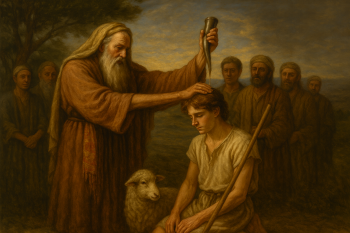
And Samuel said to Jesse, ‘Are all the young men here?’ Then he said, ‘There remains yet the youngest, and there he is, keeping the sheep.’ And Samuel said to Jesse, ‘Send and bring him. For we will not sit down till he comes here.’ So he sent and brought him in. Now he was ruddy, with bright eyes, and good-looking.
And the LORD said, ‘Arise, anoint him; for this is the one!’ Then Samuel took the horn of oil and anointed him in the midst of his brothers; and the Spirit of the LORD came upon David from that day forward. So Samuel arose and went to Ramah.” (I Samuel 13-16:1NKJV)
Our lesson – Samuel doesn’t announce his true heavenly purpose to the town’s elders, but he accomplishes his mission – find the next king and quietly anoint him. Young David doesn’t even know his appointed future, but the Lord has chosen His next king, and Samuel has publicly implemented the plan.