Of all the options one has for opening an important new book of the Bible, why start by telling us the month and year when it occurred? At first, it seems quite boring. As a reminder, here’s the very first verse of Nehemiah chapter 1:
“It came to pass in the month of Chislev, in the twentieth year…” Nehemiah 1:1a
Sorry, but at first, I’m surprised and frankly a bit annoyed at this trivia. Where’s the political intrigue? Tell me about the plots against Nehemiah’s life! How does he negotiate for supplies with the king?
But, wait… let’s pump the brakes for just a moment. Remember, this is an incredibly important story about a man strategically positioned to change history. He’s about to restore dignity and spiritual strength to the holy city of Jerusalem. Back in that day, cities without walls had no prestige. They were subject to military attack and political exploitation. We’re about to read how Nehemiah’s heart is moved to change that. He has a protective spirit toward his countrymen and for this place he has never visited.
Do we have enough faith to accept that there must be a reason that Nehemiah mentioned the month and year of this original visit? So let’s be patient. When chapter two opens, we will receive an answer to this question about the calendar.
First, please note that Chislev, the month of the visit, is similar to our month of December. The ancients described the year by measuring how long a particular king had been on the throne. So, we have a timestamp at the beginning of the story. We know that the visit occurred in the ninth month of the 20th year of Artaxerxes’ reign. Now, in Chapter 2, we learn when Nehemiah’s conversation with the king finally took place. This is about to get important.
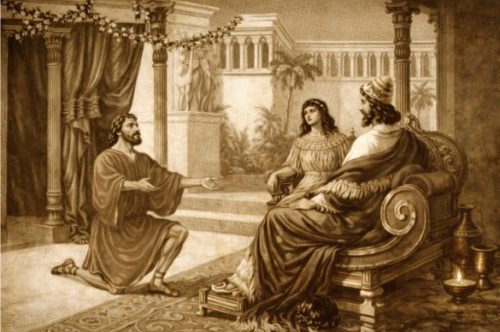
And it happened in the month of Nisan, in the twentieth year of Artaxerxes the king; wine was before him. And I took up the wine and gave it to the king. Now I had not been sad in his presence before. And the king said to me, “Why is your face sad, since you are not sick?” “This is nothing but sorrow of heart.” Then I was very much afraid.
Let’s address two quick points. First, we have an answer to our original calendar question. Nisan was the first month of the new year. In ancient times, they measured time by lunar months, not solar, meaning there were thirteen months in their year. Once again, the Bible offers remarkable specificity if we are patient to receive its detail with humility. This “trivial issue” about the dates indicates that four months had passed since Nehemiah received his visitors. He had apparently been praying for four entire months when the king noticed his sad countenance. Why so long? We’re not told, but it’s quite possible that King Artaxerxes had been visiting another region of his empire during those four months. He returns to find his cupbearer in a disheartened condition.
This leads to the second point. A sad countenance was a reproach to the one in authority — especially in ancient times. It might indicate that the person was displeased with the king. It could indicate that there is an unresolved problem the leader has not addressed. Once again, this could be seen as an insult to the king. Or, it could indicate a strain on Nehemiah’s conscience. Perhaps he’s plotting against the king?
Nehemiah needs to be very careful and he knows it, which is why we read, “Then I was very much afraid.” We’re about to observe one of the most important political conversations in history. If all goes well, Nehemiah’s project will reestablish the socio-economic strength of Jerusalem. These people don’t realize it, but Jesus is coming in four centuries. Jerusalem needs to be restored. We need this wall built!
When the Bible offers specifics, such as an amount of money or a chronology, we are wise to pay attention. In this case, the importance of Nehemiah’s request, the resources and the time needed to rebuild Jerusalem, requires four solid months of prayer and repentance before God. Nehemiah is ready to respond to the king’s question. Notice how he begins:
And I said to the king, “Let the king live forever!”
This diplomatic compliment serves to dispel any accusation of disloyalty. Nehemiah continues:
“Why should not my face be sad, when the city, the place of my father’s tomb, lies waste, and its gates are burned with fire?”
In one short rhetorical question, Nehemiah provides dramatic, clear evidence for his sadness. He avoids offering a bland, hyper-empathetic, worldly sorrow for his countrymen.
And the king said to me, “For what do you ask?”
Notice how quickly the King seeks a practical solution. When a senior executive hears an authentic problem, his thoughts immediately turn to results. Is Nehemiah prepared for this sudden question? Isn’t it enough to feel badly? Have you noticed how, in recent times, one is given spiritual credit just for feeling deeply?
So I prayed to the God of Heaven.
Although we don’t specifically know the elements or duration of Nehemiah’s prayer, it is reasonable to assume he is not asking for fresh revelation. He just spent four months on his knees asking for mercy from the king and detecting God’s will for Jerusalem. By now, he knows the resources he’ll need and the plan he needs to implement. The moment has arrived to appeal to the king. His years of loyal service have earned Nehemiah the chance to express his concern without fear of retribution. His brief prayer is a momentary “death to self” and acknowledgement of God’s holiness and leadership.
And I said to the king, “If it please the king, and if your servant has found favor in your sight, I pray that you would send me to Judah, to the city of my father’s tombs, so that I may build it.” And the king said to me (the queen also sitting by him)
- For how long shall your journey be?
- And when will you return?
Again, we see the need for specifics. Too often, I fear, a person receives a vision or calling from God and expects resources to flow without regard for specifics. The Bible is teaching us wise project and fundraising management techniques. Nehemiah was likely aware of the three constraints on a project – time, budget, and standards. He remained focused. He didn’t add unreasonable complexity and detail to his request. He stayed strategic and allowed the king to drill down for more detail. Apparently, the king trusted Nehemiah to maintain excellent building standards. He was not concerned with cost or resource management or manpower. His questions focused on the amount of time it would take to complete the project. We later learn that this entire mission, accomplished against incredible opposition, required just 52 days.
Nehemiah continues, realizing he will likely run into political opposition. Not everybody will be content to see Jerusalem come back to life. There are likely going to be those who have been exploiting the civic decay for their own benefit. So he asks the king for political protection, by carrying letters to the local governors. He further asks for the timber needed to build the walls and to build a house of his own.
So it pleased the king to send me, and I set him a time. And I said to the king, “If it please the king, let letters be given me to the governors beyond the river, so that they may let me pass through until I come to Judah and send a letter to Asaph, the keeper of the king’s forest, so that he may give me timber to make beams for the gates of the palace which belonged to the house and for the wall of the city and for the house to which I will enter.” And the king granted me what I asked according to the good hand of my God upon me.
To wrap up the preparation phase of this important story, let’s return to the question that opened this chapter. It seems that the Lord is teaching us how to get His attention. If Nehemiah stayed in prayer for four months to prepare for this conversation with King Artaxerxes, and received an instant, favorable reply, perhaps we can apply this lesson to our own modern lives.
Nehemiah has successfully invoked the promise of 2 Chronicles 7:14:
If My people who are called by My name…
This refers to the people of Israel — those beloved of God. They are the ones who are called by God‘s name.
Will humble themselves, and pray, and seek My face…
This describes a need to avoid self-reliance and to focus on God’s plans through humility and persistent prayer.
And turn from their wicked ways…
The former generations had worshipped idols instead of the Lord. This phrase calls for a heart of repentance—a conscious decision to change direction and follow God’s way.
Then I will hear from heaven, I will forgive their sin and heal their land.
The Lord wants to restore and forgive. Nehemiah has followed the prescribed course of action.
He has invoked the protection and restoration pattern outlined in Chronicles. According to this important verse, he had a right to expect that he activated the Lord’s favor. Now consider the purpose and the concerns which occupy your heart. You can invoke these promises, as well.