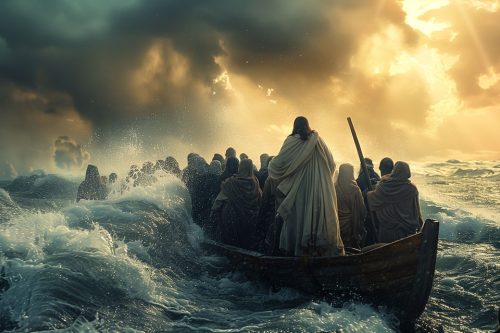
Early in his ministry, Jesus finished a powerful teaching to a large crowd on the north shores of the Sea of Galilee near Capernaum. He then asks to be taken to another region on the south side of the water. The Gospel of Mark reports:
————————————————-
“On the same day, when evening had come, He said to them [His disciples], “Let us cross over to the other side.”
Mark 4:35
————————————————-
Having finished up His work in Capernaum, Jesus wants to go on a missions trip! By referring to “the other side,” He is speaking of the other side of the Sea of Galilee, to the Gadarenes, about 13 miles due south. Or is He saying something else? By mentioning “the other side,” is He actually making a cultural reference? Is He about to take His message to non-Jewish people? In an upcoming Journal article, we will learn that there’s something quite unique in the region where He’s headed.
————————————————-
Normally, with favorable winds, a fishing boat could cross the sea in about two hours. But…something severe happens on the way. A wicked storm brews up, as if the Earth itself were blocking His path.
And a great windstorm arose, and the waves beat into the boat, so that it was already filling. But He [Jesus] was in the stern, asleep on a pillow. And they awoke Him and said to Him, “Teacher, do You not care that we are perishing?” Then He arose and rebuked the wind, and said to the sea, “Peace, be still!” And the wind ceased, and there was a great calm. But He said to them, “Why are you so fearful? How is it that you have no faith?” And they feared exceedingly, and said to one another, “Who can this be, that even the wind and the sea obey Him!”
Mark 4:37-41
————————————————-
Let’s rewind a bit and unpack this fascinating story.
Jesus starts by simply leading His team to cross the Sea. He is declaring His intent to expand the reach of His ministry. The team begins the crossing in the boats during the evening, but they run into a wicked storm during the night. They wake Jesus, not to ask for His help, but to challenge His compassion for the deadly situation: “Do you not care that we are perishing?” The disciples interpret His peaceful sleep as a lack of concern for their safety.
Notice that Jesus awakes from a deep sleep and immediately applies keen spiritual discernment to the situation. Reread that passage above and you’ll notice that He 1) rebukes the wind, 2) speaks peace to the sea and 3) exposes their lack of faith. Why use these different methods?
- Jesus rebukes the wind because He knows that Satan is the cause of the storm. Paul later writes in Ephesians 2:2 that Satan is the “prince of the power of the air.” The word “air” is the space between heaven and earth where the enemy uses his evil forces to exert influence over the spiritual and physical realm. Remember, Adam’s sin yielded management authority to the devil to stir up havoc in God’s creation. So Jesus rebukes the storm knowing the devil is behind it, in an attempt to delay Jesus and His Kingdom mission and to provoke fear and doubt in His followers. By rebuking the storm, Jesus is actually rebuking Satan. The wind immediately ceased.
- Then He spoke peace to the sea because “the Earth is the Lord’s and all it’s fulness therein” Psalm 24:1. The sea was simply responding to the angry storm. Jesus spoke peace to His creation, and it quickly responded.
- Finally, He reframes the disciples’ fear. Instead of acknowledging any physical danger, He exposes their spiritual poverty asking: “Why are you so fearful? How is it that you have so little faith?” Without faith we cannot accomplish anything of a spiritual nature. Even after the deadly problem is solved, the travelers reacted with fear: And they feared exceedingly, and said to one another, “Who can this be, that even the wind and the sea obey Him!”
Incidents like this offer us a teaching moment. The disciples were still uncertain who Jesus really was. Is he a great new Rabbi? Is He really the Messiah as some have claimed? This is why they asked: “Who can this be, that even the wind and the sea obey Him!”
Challenging circumstances like these need to arise at times in order for Jesus to demonstrate the use of God’s authority and power to accomplish supernatural outcomes. His team is being trained to develop spiritual disciplines and to release faith in hostile situations.
INSIGHT #1: CONNECT THE STORM TO YOUR ASSIGNMENT — all hell will likely break loose when you are called to expand territory for the Kingdom. It happened to Jesus in this passage, so we too should anticipate serious challenges when we’re about to use our influence to expand the Lord’s Kingdom. Satan is not happy at all when he notices God’s call on our lives. He erects multiple distressing barriers to dissuade us. Expect and prepare for it; put on the whole armor of God to push through it.
Jesus had the deep insight to rebuke the storm and not be victimized or intimidated by it. He certainly didn’t allow the storm to block His path. He was on assignment! He had spiritual assurance that His Father had Him on a mission. When we receive assignments from heaven, and storms brew up in advance, do we have the insight to connect the two?
INSIGHT #2: LEARN TO DECODE THE SPIRITUAL IMPLICATIONS
Recall what Solomon taught 1,000 years before this incident. “Wisdom is the principal thing; Therefore get wisdom. And in all your getting, get understanding.” Proverbs 4:7
What is Solomon teaching us? Wisdom is the ability to look at an incident through God’s eyes – using His framework to decode the spiritual principles behind a situation. Understanding is the ability to act on the principles — the outworking…the application.
Jesus woke from a dead sleep. He immediately ascertained the truth behind the circumstances, He acted speedily and with spiritual acuity. He knew that Satan was stirring up the storm, that the sea was merely responding and that the men were reacting with emotion and fear rather than faith. He decoded the situation and applied rapid, incredibly wise insight during a dangerous moment.
We are called to respond like this, as well. Jesus said, “Greater things than these you will do in my name.” Let’s take Him at His Word. Read the Bible; pray for wisdom; learn to apply God’s principles in challenging moments.